Below are mild spoilers for “The Breakfast Club” (1985).
In 1985, five fictional teenagers sat in a high school library for Saturday detention, and on paper, nothing about their day seemed remarkable. Yet, when “The Breakfast Club” first hit theaters, it detonated Hollywood’s conventional portrayal of American teenagers. Now, forty years later, the film continues to influence the media’s depiction of adolescence.
“The Breakfast Club” remains one of the most popular movies of 1985, grossing $51.5 million domestically. Its soundtrack reached No. 17 on the Billboard Hot 100 while the movie’s nearly-synonymous theme song, “Don’t You (Forget About Me)” by Simple Minds, reached No. 1, catapulting the picture’s status into the realm of cultural phenomenon.
Before John Hughes, the film’s director, emerged as the “auteur of teenage angst,” the landscape of teen movies was notably different. Movies such as “Animal House” (1978) and “Porky’s” (1981) often leaned towards raunchy comedy and caricatures driven by commercial formulas, simply to yield a profit at the box office.
Then came Hughes. The director found his forte when he started writing, producing and directing his own films about the subtleties of teenage life, inspired by his childhood growing up in the Chicago suburbs. His candid interpretation of the teen genre garnered him a rapid following through films like “Sixteen Candles” (1984) and “Ferris Bueller’s Day Off” (1986).
Jason Diamond, author of “Finding John Hughes,” told The Black & White that Hughes understood the inner workings of Gen-X teens, who their Baby Boomer parents often overshadowed, on a deeper level than many of his contemporaries.
“He showed teens as people, not just kids who don’t know what’s good for them and need to grow up,” Diamond said. “Before that, most movies either factored out that teens are as complex and full of emotions as the rest of us, or they made them dark and moody in the mold of James Dean.”
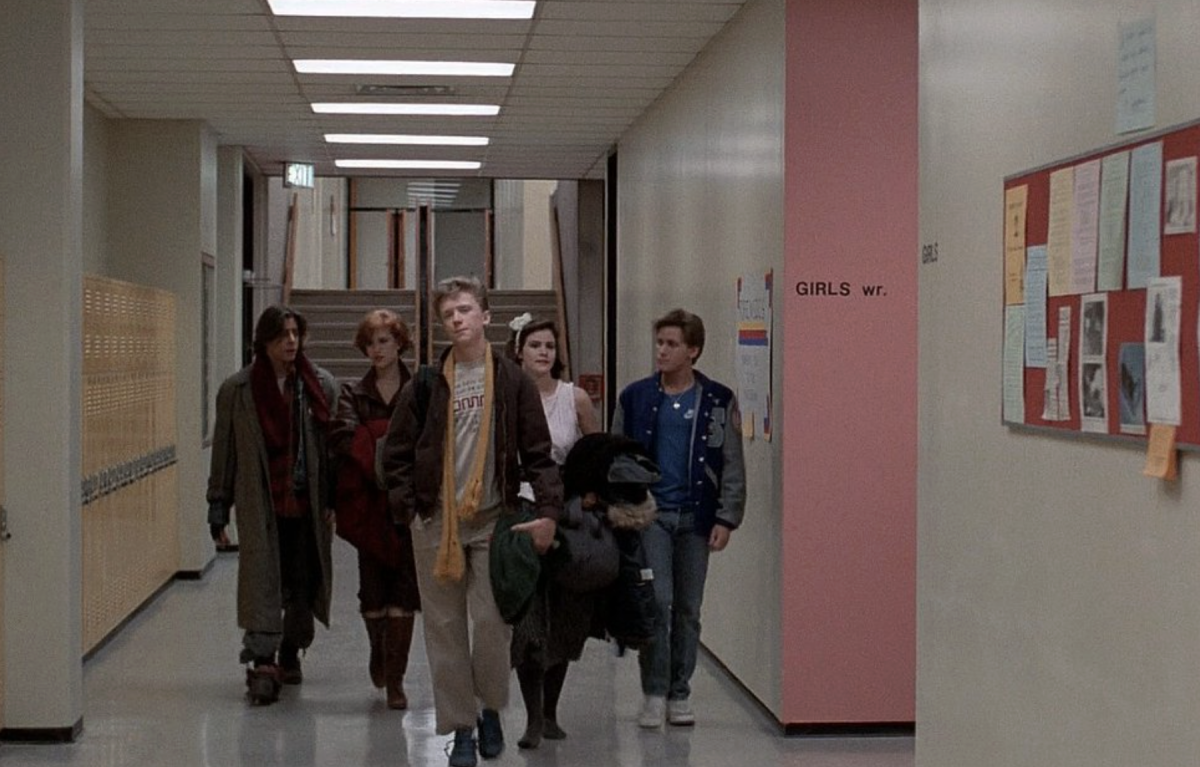
The characters of “The Breakfast Club” first appeared as the familiar stereotypes many movie-watchers know by heart: the brain, Brian (Anthony Michael Hall); the athlete, Andrew (Emilio Estevez); the basketcase, Allison (Ally Sheedy); the princess, Claire (Molly Ringwald); and the criminal, Bender (Judd Nelson). However, by the end of the film, each character sheds their narrow archetype, freeing themselves from the judgment of their peers and finding respect for one another in the process.
Built on a “ship of fools” premise — where an unlikely group must confront their differences in a limited space — “The Breakfast Club” confines five students to Saturday detention in the library of Shermer Oak High School. The film follows the dialogue-driven precedent of the courtroom drama “12 Angry Men” (1957) with its singular setting and focus on moral conflict, operating similarly to a stage play. The five characters, at first reluctant to acknowledge each other’s presence, soon bond over their shared disdain for their principal, Mr. Vernon (Paul Gleason), an antagonist who fuels a connection that transcends cafeteria politics.
Kelly Cole, Georgetown University Dean and film professor for the course “Cultural Narratives of the 1980s,” said that “The Breakfast Club” maintains significance today because of its emphasis on character-driven plot devices.
“It’s like anthropology,” Cole said. “It’s just the social fabric of the way people are when they go into little groups.”
The film captured the shifting landscape of families in the Reagan era and its impact on adolescents. In the 1980s, rising divorce rates and the increase of dual-income households, spurred by the Women’s Liberation Movement, produced a generation of children grappling with degrees of emotional neglect and indifference. Claire, a child of divorce, attempts to maintain a certain appearance and level of perfection to ease the chaos in her home life. Allison represented the growing number of “latchkey” kids in the ’80s — a term referring to those who mostly get to, from and through school on their own. As the cynical child of a broken home, Allison delivers one of the film’s most quoted lines: “When you grow up, your heart dies.”
Hughes depicted his characters’ respective mental health struggles as a result of unstable family dynamics and the damaging nature of stereotypes. Allison, the recluse, hides behind silence and Bender, the rebel, masks pain with sarcasm. In the screenplay, Hughes developed these traits as coping mechanisms, acknowledging the weight of familial and societal pressures that teenagers face.
Cole says the reason the film appealed to teenagers was that it captured the disconnect often felt between teens and their parents during adolescence.
“It opened up the door to having things from a perspective where the stakes of teenage life matter,” Cole said. “There’s a very big throughline in ’80s movies in general, where authority figures are just either incompetent or malicious or just checked out. I think this really focused on that to be like, ‘There’s this world you live in that has nothing to do with your parents’ influence.’”
Film and cultural critics deemed “The Breakfast Club” groundbreaking not only in its in-depth character analysis, but also in its handling of mental health issues that few other directors were willing to address. The media either sensationalized or ignored previous mentions of teenagers’ mental health, even though it was a pressing concern throughout the 20th century; between 1950 and 1980, suicide rates tripled among teenagers.
Audiences viewed the popular “afterschool TV specials” of the early ’70s as failures to connect with teens on their level. They blended condemnation of teen culture and attempts at empathy closely, alienating many teenagers.
Hughes’ movie, however, set out to treat teens’ mental health with nuance, including the complicated struggles of Brian, who the film first characterized as a model high-achieving teen desperate to please authority figures. As the main characters progressively bond and share vulnerabilities with one another, Brian reveals that he’s in detention for the possession of a flare gun in his locker, which he planned to use to commit suicide with after receiving an F in shop class. Though a seemingly exaggerated archetype, the unflinching acknowledgement of teen suicide was mostly taboo in mainstream popular films.
Parental pressure and the fear of academic failure led to a feeling of worthlessness for Brian; anxieties that continue to resonate with high school students. Junior Olivia Mosier said the mental health concerns expressed in the movie are still rampant among teens, including at Whitman.
“Whitman students are obviously overachievers,” Mosier said. “Trying to do everything is just impossible. Talking more about mental health, as seen in ‘The Breakfast Club,’ is crucial to improving our school’s culture.”
The film, like many of its era, has received criticism for its outmoded misogynistic narratives. Throughout the film, Bender consistently makes crude sexual remarks towards Claire, objectifying her but receiving no backlash. The film even reframes his sexual coercion as romantic or effective when the two kiss in the closing scene. The rest of the group also ignores Allison until she undergoes a physical transformation — a change that commentators suggest marks feminine conformity as a prerequisite for romantic attention.
“The Breakfast Club” star and ’80s icon Molly Ringwald, in an article published in The New Yorker, revisited the film in the age of the #MeToo movement, a 2017 social media awareness campaign against sexual abuse.
“How are we meant to feel about art that we both love and oppose?” Ringwald said. “What if we are in the unusual position of having helped create it?”
However, many also praise the film for some of its progressive storylines. Claire and Allison, for example, discuss the constantly-debated crux of teenage girlhood: the “slut versus prude” complex. Their conversation unveils their own internalized misogyny, bonding the two girls from opposite sides of the social spectrum over the pressure to lose their virginity.
“Well, if you say you haven’t, you’re a prude,” Claire says in the film. “If you say you have, you’re a slut. It’s a trap. You want to, but you can’t, and when you do, you wish you didn’t, right?”
“The Breakfast Club” continues to inspire the filmmakers behind many of the movies and TV shows Gen Z love today. “Spiderman: Homecoming” (2017) drew heavily from ’80s teen comedy, including a running sequence as an homage to “Ferris Bueller.” Zendaya, who plays lead MJ in the Spiderman series, cited “The Breakfast Club” character Allison as inspiration for her character’s guarded and brooding personality. Josh Schwartz, writer and producer of Gossip Girl and The O.C., also cited Hughes as a role model.
Kevin Smokler, author of “Brat Pack America: A Love Letter to ’80s Teen Movies” first saw “The Breakfast Club” at a seventh-grade sleepover in 1985. At 13, he was too young for R-rated movies in the theater but just old enough to resonate deeply with the scenes he saw play out on screen. He told The Black & White that “The Breakfast Club” blazed a trail for the dialogue of other classic teen media such as the film “Clueless” (1995) and the TV melodrama of “Dawson’s Creek” (1998-2003).
“There’s probably 800 movies that wouldn’t have existed if not for John Hughes,” Smokler said. “Without ‘The Breakfast Club,’ there would be no ‘The Summer I Turned Pretty.’”
While fashion, soundtracks and camera quality have all evolved since 1985, teens are still tuning in to “The Breakfast Club.” Mosier found the film’s message compelling, underscoring how empathy can bridge social divides.
Smokler added his theory that Gen-Z resonates with the spontaneity of 1980s teenage life portrayed in the movie.
“They’re stuck and there’s nothing to distract themselves with — this is before mobile phones,” Smokler said. “The idea that you have to spend eight hours with a group of people who are your age, and something great might happen on the other side is an experience that young people no longer have, and probably wish that they did.”
The film concludes by revealing each character’s new emotional headspace after they learn that their peers, whom they had stereotyped on a superficial level, struggle with the same adolescent anxieties. The question remained at the end of the film: after the teens were released from detention and returned to school on Monday, would they revel in their shared experiences or return to their default social groups? While “The Breakfast Club” never answers the question, it ends with Bender raising his fist in the air — a gesture that has since become one of the film’s most recognizable images, symbolizing the indelible impact of high school relationships.
“I remember watching ‘The Breakfast Club’ when I was 15 or 16, over a decade after its release, and not only feeling like I could get along with any of the people serving detention that day, but that I also could see myself in each of them and understand what each of them is going through,” Diamond said. “It’s something that will always shine through.”