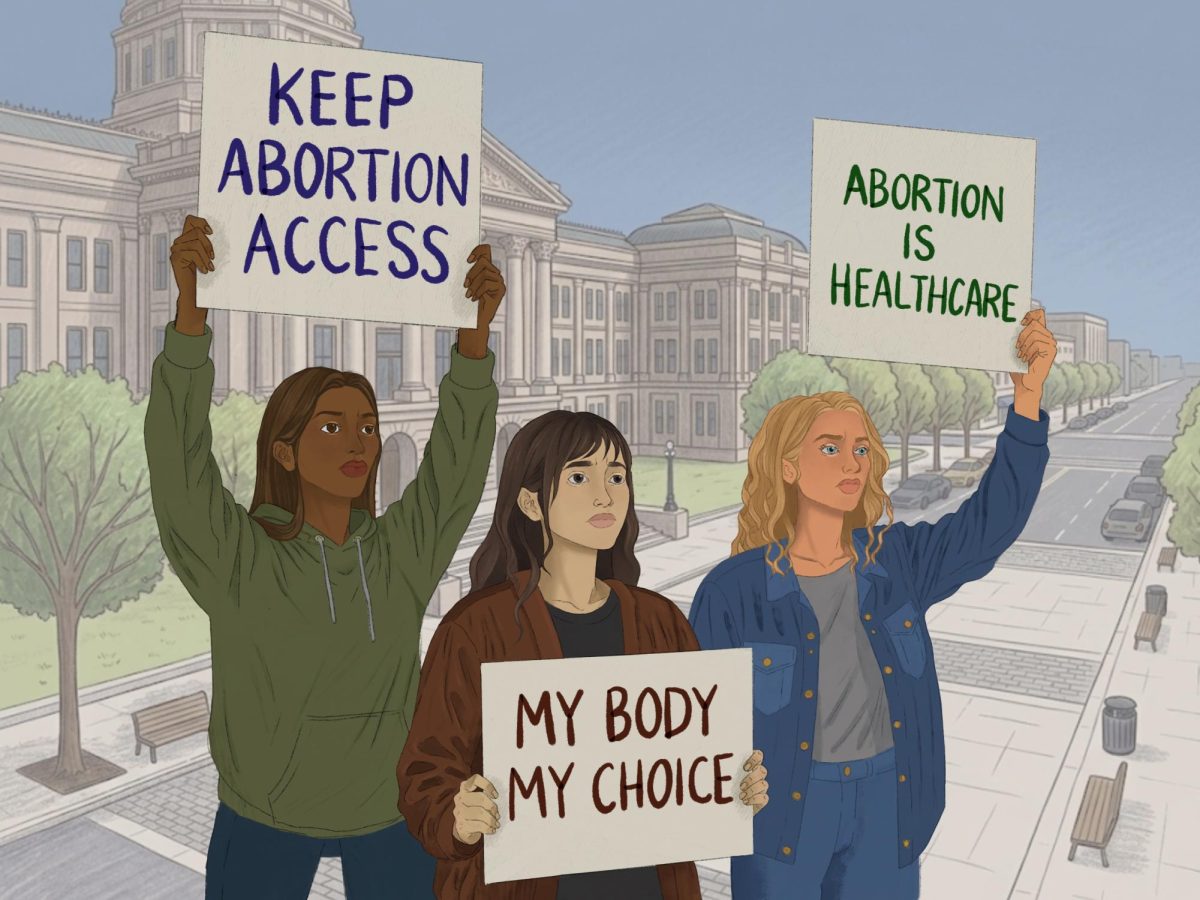
On a sunny summer day, a ruling rang through the ears of millions of devastated women nationwide. The Supreme Court had overturned Roe v. Wade. This June will mark four years since the decision, the effects of which still ripple throughout the United States today.
On June 24, 2022, Dobbs v. Jackson overturned the landmark Roe v. Wade, removing federal protections for abortion care across the country. While Roe v. Wade stated that the 14th Amendment protected the right to abortion, Dobbs v. Jackson ruled that the Constitution does not specifically guarantee the right to abortion, so it cannot be federally protected. Instead, the government left the states to decide whether their residents would have access to abortion.
As the midterms approach in November, voters must consider the true intentions of each candidate regarding abortion protections. Nearly two-thirds of the public disagreed with the Dobbs decision, so citizens and voters should re-evaluate whether their representatives truly have represented their interests in recent years. Along with voting, advocates in these states should continue their work, as they can still make progress
As of April 2026, 41 states have abortion restrictions of some degree in place, and 13 of those states implemented total abortion bans following Dobbs. Such restrictions are typically based on an estimate of the length of a person’s pregnancy, ranging from six-week bans to bans after 18 weeks. In the Dobbs era, state legislatures have empowered law enforcement and private companies to use data tracking to monitor the activities of women seeking out-of-state healthcare. Now, states are working to prohibit women from using certain public roads to obtain an abortion in legal states.
Jodi Quintero is a partner at GMMB, a prominent communications firm in Washington, D.C. She worked on ballot initiatives to protect abortion rights across multiple states, and said that Roe’s overturning has become dangerous.
“For the longest time, everybody thought that Roe v. Wade protected all of our rights, and no one ever thought it would be overturned because it was precedent,” Quintero said. “But then the court changed, and it really endangered women’s lives all over the country.”
The decision to overturn the case sparked rampant protests nationwide. In Chicago, massive crowds chanted “My body, my choice!” in front of a federal building. Similar protests erupted across the country. But these protests were relatively short-lived as federally protected abortion care drew farther and farther from reach. In 2022, there were at least 3,071 protests regarding abortion across just three months. While 2022 showcased a huge peak in pro-choice abortion protests, it has since decreased dramatically. There are now fewer protests solely focused on abortion access and more protests based on women’s rights as a whole, so the call to abortion rights can sometimes be muddled.
As restrictions continued to develop state by state, women began resorting to out-of-state travel for access to abortions. Though it’s currently federally legal to travel to other states for this kind of care, many states, such as Texas, are working to restrict that option with travel bans. Notably, Amarillo, Texas, attempted to pass one such travel ban, which would have prohibited the use of local streets and expressways to seek out-of-state abortion care. Though unsuccessful, these restrictions would be incredibly harmful because they could force women to find other, more dangerous methods of care.
Travel bans address a much more nuanced issue than other forms of restriction since they restrict residents’ freedom to travel across state lines, disregarding laws already in place in states. Amrutha Chatty, a managing supervisor at GMMB who has worked as a political media consultant to protect abortion in states across the nation, said that the travel bans are a concerning escalation.
“To think that crossing state lines to seek medical care — a basic right that we’re supposed to have in this country — is something that could be legally punished is so terrifying,” Chatty said.
Those who embrace abortion bans usually refer to themselves as “pro-life,” viewing abortion as ending lives and aiming to protect those lives with bans. The results of these bans, however, tell a different story. Since Roe’s overturning, the mortality rate for pregnant women has nearly doubled. Simultaneously, states with these bans in place are facing higher infant mortality rates than they did before Dobbs.
Hospitals themselves are proving dangerous in states with severe restrictions. Several high-profile cases of ectopic pregnancies — where a pregnancy has matured outside of the uterus — have gained national attention since 2022. Seeking care for ectopic pregnancies, two women, Taysha Wilkinson-Sobieski and Amber Nicole Thurman, died in states where it had become illegal for doctors to save their lives. Similarly, untreated or undertreated miscarriages can also prove fatal to women, and states now limit how doctors may respond. At least 12 women as of 2024 had died as a result of the Dobbs decision and resulting state legislation. Johns Hopkins researchers in 2026 estimated that the new bans were causing over a 9% increase in pregnancy-associated deaths.
Not only does the Dobbs decision lead to higher mortality rates, but it also advances racial disparity. Restrictions since Roe have disproportionately affected people of color: following the Dobbs ruling, Black women seeking pregnancy care are more than three times as likely to die in states that ban abortion as white women are, compared to two times more likely in 2019. Discrimination in healthcare, systemic racial biases and health inequities contribute to this disadvantage.
When legal restrictions leave women unable to find care, they may resort to unsafe measures for life-saving purposes. In life-or-death pregnancy situations, criminalizing abortions does not stop women from getting them; it only takes away access to safe, secure abortions. Women may resort to illegal abortions under unsafe, uncontrolled conditions, oftentimes without medical professionals, which contributes to higher death rates for women and potentially devastating complications. Maternal deaths in response to unsafe abortions are underreported and misclassified because of stigma. They are often caused by incomplete abortions, hemorrhages, infections, uterine perforation and more.
Maryland State Sen. Sara Love has worked as an avid reproductive justice advocate for over 10 years. Working alongside Planned Parenthood, Love has seen the adverse effects of restrictive abortion bans and has contributed to prominent protective legislation once elected to the state legislature. Love said that post-Dobbs abortion regulations overly dictate what women can and can’t do with their bodies.
“I have seen how much ensuring that women have control over their own bodies makes a difference in how women are viewed in our society,” Love said. “I mean, do we think of them as moral, ethical beings able to make their own decisions for themselves and their lives, or do we think of them as just property?”
But after four years, the fight is still alive. Through various forms of activism, such as the widespread implementation of ballot initiatives, advocates have harnessed available avenues to effect real change in their communities. These ballot initiatives allow for grassroots campaigns to propose statutes or constitutional amendments.
For example, in 2024, Maryland ballots featured the Maryland Right to Reproductive Freedom Amendment initiative. Passing with an overwhelming 76% majority, the initiative was officially inducted into the Maryland Bill of Rights, protecting “an individual’s fundamental right to reproductive freedom.” Though it was an immensely crucial protection, its success didn’t come as a surprise. Maryland’s population is primarily composed of registered Democrats, who are most likely to support pro-choice legislation.
Since Dobbs leaves regulation surrounding abortion up to the states, and states composed of a majority pro-choice population are more likely to adopt pro-choice statutes, that’s where the most success in advocacy is happening. Meanwhile, states with heavier restrictions, which are typically Republican-leaning, are seeing increasingly demoralized advocacy and less progress.
Activism is even more vital in states that do have restrictions, as progress in these states takes larger strides towards federal abortion protection. Since Dobbs, numerous state legislatures — including some red states’ — have passed ballot initiatives to increase access to abortion as an option for women. For example, Ohio, a majority Republican state that previously banned abortion care at six weeks, passed a ballot initiative of its own, adding a section to the state constitution to guarantee the right to an abortion up until “fetal viability.”
Many states, including Ohio, have secured reform through ballot initiatives, a substantial step towards success. Because Ohio is traditionally a conservative state, Chatty said it was an inspiring display of change in an unexpected place.
“Ohio is a red state where you don’t always think that these types of issues may win,” Chatty said. “When it affects health and people’s lives, it becomes more than politics.”
Other states that have passed ballot initiatives to secure state-protected care include New York, Kansas, Arizona and Maryland. Though these were monumental wins, they came with shortcomings. For example, efforts to pass a ballot initiative in Florida, where bans were incredibly strict — namely, a six-week abortion ban — were unsuccessful. Ballot initiatives in Florida require at least 60% voter approval to pass, so even with over half of voters supporting the reform, it ultimately failed.
The argument that states should retain the right to violate Americans’ rights is short-sighted. Since 2022, states have used the power the Supreme Court granted them to attempt to expand the power into other states’ jurisdictions. State lawmakers are creating a system of surveillance that takes state law and turns it federal. These small and inconsistent ballot initiatives are vulnerable attempts to do what Roe had already done so well for the nation.
Ballot initiatives are just the start of a chain for reform, and the work to achieve federally protected care must continue. Step by step, strides can be made as long as advocacy is enforced. Although four years have passed, advocacy should continue, and the numbers don’t lie: that advocacy will save lives.