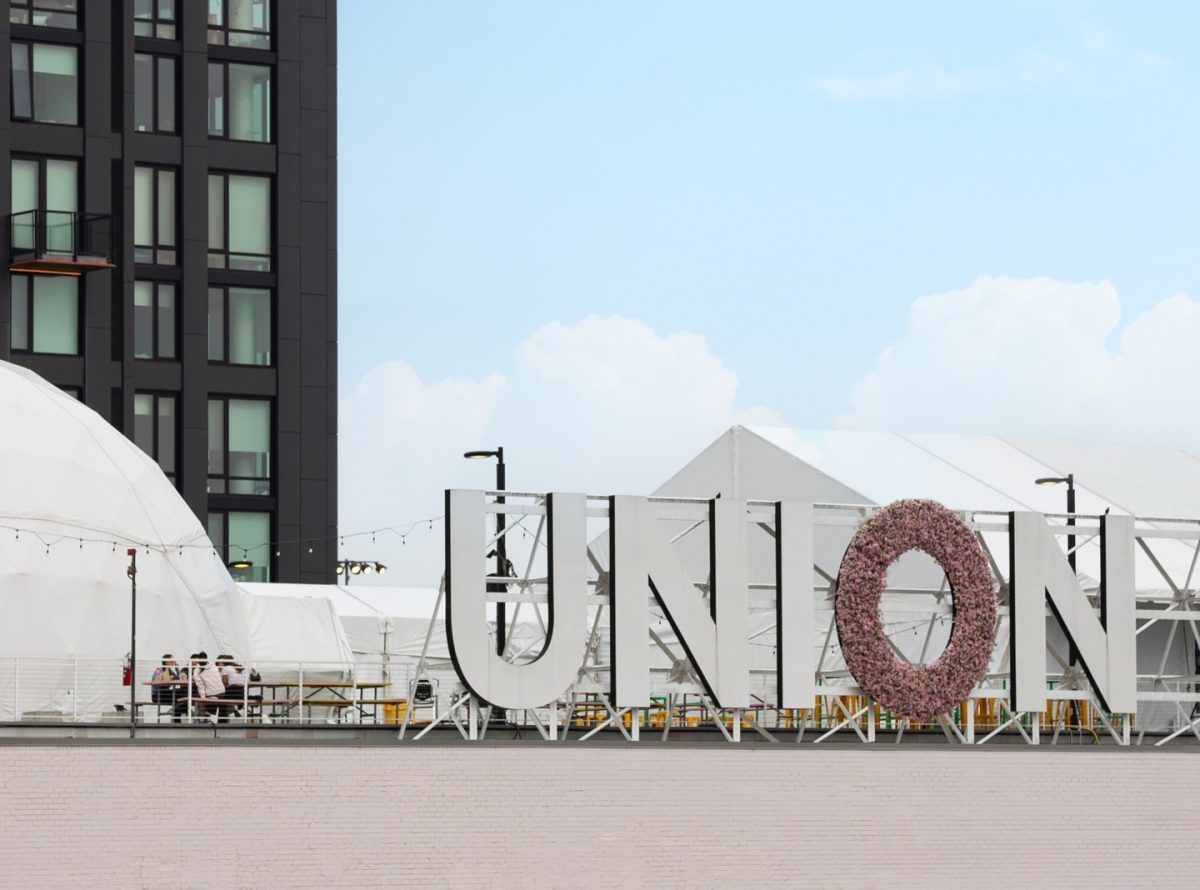
Steam rises from stovetops at Egg Yaki and El Cielo, while knives strike cutting boards in steady rhythms at Cordelia Fishbar. Servers pipe doughnuts full of gooey raspberry jam at the Handcrafted Doughnuts stall as the scent of freshly baked bread from Bread Alley drifts through the market. Union Market, 1309 5th St NE, buzzes with activity.
Union Market turns 100 years old in 2026. Beneath the concrete floors and glowing signs lies a history rooted not only in trends or tourism but also in survival. Union Market began as Washington’s primary food lifeline, built to feed a growing city and sustained for decades by immigrant labor. With roots that stretch back over 200 years, the market remains a unifying and vibrant gathering place for the community. For much of the 19th and early 20th centuries, Centre Market operated near what is now the National Mall.
In its earliest days, Center Market was no more than a collection of ramshackle wooden sheds. Bordered by the Washington Canal, the marshy land earned it the nickname “Marsh Market.” It became one of the largest open-air markets in the country. It served as the primary location where farmers, butchers and fishmongers sold food to Washington residents, making it an essential part of daily life in the area.
As the city of Washington grew, so did complaints regarding the dirt and disorder of the public market. In response, a group of investors formed the Washington Market Company in 1870. It hired architect Adolf Cluss to design a modern new market facility facing Pennsylvania Avenue. The elaborate Center Market building attracted thousands of customers daily, with streetcar lines from all corners of the city converging at the market.
Designed to appeal to middle-class marketers, the market building was thoroughly modern and hygienic. The facility boasted high ceilings with ventilated skylights, electric lighting, cold-storage vaults and a spacious eatery. For a nominal fee, street vendors, or “hucksters,” could sell wares outside of Center Market. Hucksters packed the streets around the market, hawking seasonal goods, greenery and even preparing food at open-air restaurants.
Center Market returned to public ownership in 1921 and was managed by the U.S. Department of Agriculture. However, this shift was short-lived. In 1926, the federal government ordered the demolition of Center Market to make way for the National Archives. Hundreds of vendors protested, many of them immigrants whose livelihoods depended entirely on market trade. However, despite the community’s best efforts, Center Market was demolished in 1931.
After Centre Market’s demolition, vendors relocated to an area in Northeast D.C. that had once been farmland and, during World War II, served as a military training camp. By the late 1920s, the area had been transformed again to accommodate city vendors who were now out of work. In 1931, Union Terminal Market officially opened.
Unlike its predecessor, Union Market was designed as a wholesale hub rather than a public shopping destination — trucks and warehouses replaced wagons and temporary stalls. The market supplied grocery stores, restaurants and institutions across the city with produce, meat, seafood and dairy. Union Market became the engine that powered Washington’s food supply. For decades, it operated almost entirely behind the scenes, remaining closed to the public.
The market was home to hundreds of immigrant-owned, generational businesses, including Greek, Italian, Jewish, Asian and Eastern European wholesalers. Their workdays began before dawn and revolved around logistics rather than visibility.
These vendors shaped Washington’s culinary scene before global cuisine became fashionable. From the 1970s to the 1990s, the majority of the market was run by Asian immigrants who also started Asian food and import businesses, such as tofu and rice cake businesses, and took over as produce, meat and restaurant supply wholesalers from previous European American business owners. Their labor introduced ingredients, preservation methods and food traditions from around the world into Washington kitchens.
Libby Rasmussen and Rajni Rao opened Vintage Vintage Vintage, a collaborative with
more than a dozen vintage curators, in the Union Market district. They reimagined the interior of an old building occupied by a bank branch first opened in 1957. The pair of entrepreneurs said that the location is brimming with potential.
“The store adds depth to Union Market District’s mix of apparel, home and lifestyle offerings – we could not think of a more perfect place to set up shop,” Rao said. “This market does not exist to impress or attract tourists. It exists to last.”
By the early 21st century, Union Market had shifted to a more commercial, business-oriented role. Modern distribution systems and large-scale suppliers reduced the need for centralized wholesale markets, so demand for rustic food sources eventually slowed, and parts of the district grew quieter. In 2011, several fires damaged buildings in the area, further accelerating the decline and prompting decisions about the market’s future.
The fire forced a reevaluation of several dilapidated spaces. Instead of abandoning the site, developers used the demolition as an opportunity to gut and rebuild the 13,500-square-foot space. The renovated Union Market reopened in September 2012 as a modernized, upscale and eclectic food destination, featuring more than 40 local artisanal vendors.
The goal of the renovation was to preserve the physical structure while redefining its purpose. The storage spaces and wholesale warehouses eventually evolved into public venues, generating a resurgence of traffic to the area. Union Market reopened as a food hall and cultural destination, inviting the public inside for the first time in decades. Today, visitors can explore more than 40 food stalls, boutiques and specialty shops all under one roof — DC Dosa serves traditional South Indian dosas with chutneys that attempt to meet the standard of street-side kitchens, Apapacho Taqueria offers bright tacos with handmade tortillas, Lucky Buns attracts crowds with warm bao buns and Fossette Focacceria brings Italian flavors in every bite. Ice cream lovers line up at Van Leeuwen, while shoppers browse handcrafted leather goods at Saint Helens Leatherworks and browse records at Byrdland Records.
Despite its modern appearance, Union Market preserved many of its origins. Where immigrant wholesalers once sold ingredients from their homelands, immigrant chefs now sell finished dishes inspired by those same traditions. The work looks different, but the foundation remains the same. The surrounding district now includes art spaces and entertainment venues such as Songbyrd Music House, where local musicians and touring acts perform, and F1 Arcade, a lively entertainment venue. Outdoor spaces such as The Rooftop at Union Market District offer skyline views and opportunities for community gatherings. Politics & Prose, an independent bookstore and café, has also become a favorite among readers and students alike.
Union Market continues to tell the story of people who arrived with little and built something lasting. It’s a story of displacement followed by rebuilding, shaped by immigrants whose labor sustained a city long before recognition followed. The next time visitors enjoy a hearty Shoyu bowl at Ramen by UZU or pick out handmade chocolates at Arcay Chocolate, they are participating in a tradition that stretches back centuries.