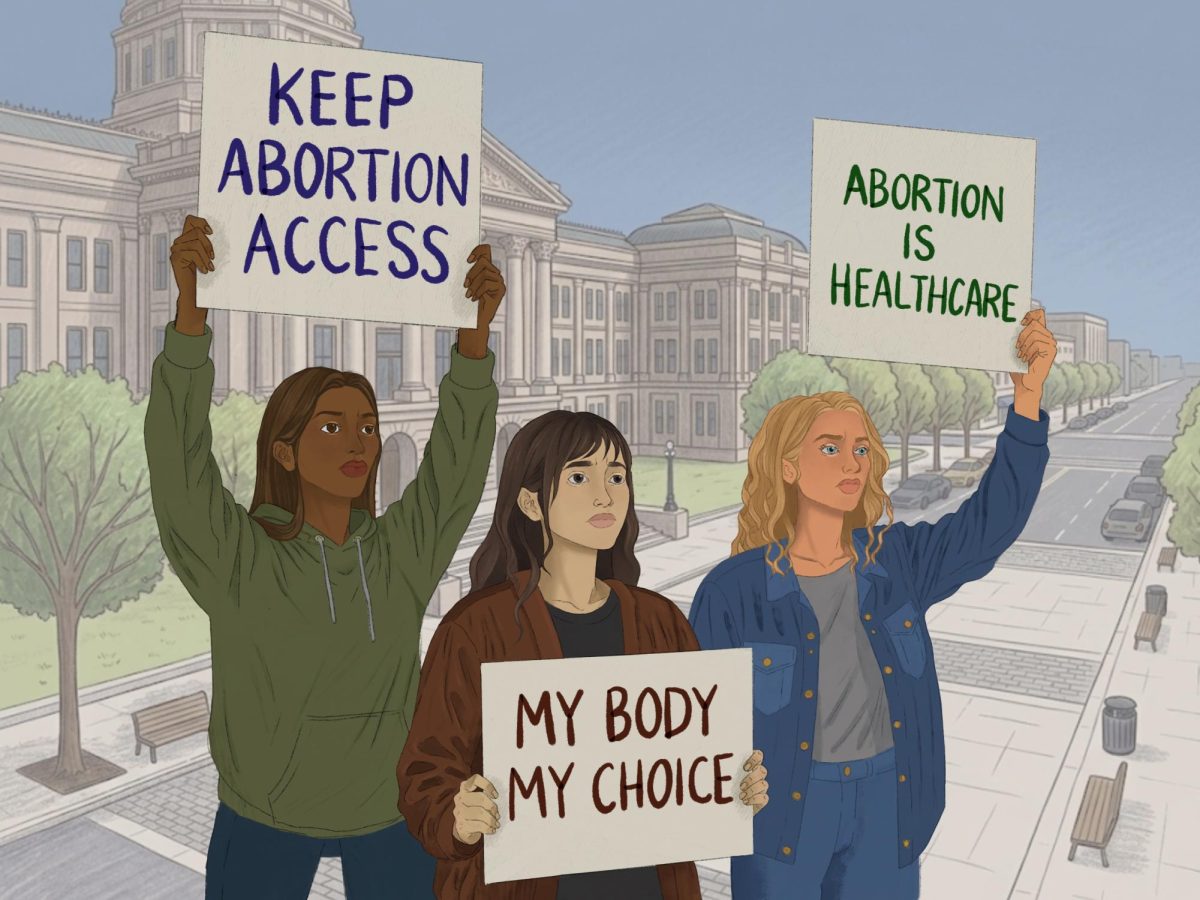
Abortion has long been a contested topic in the U.S., with proponents claiming abortion access is a woman’s right while opponents equate it to murder. Before 1973, U.S. states had the power to dictate the legality of abortion. However, in the 1973 Supreme Court case Roe v. Wade, the Court overturned a Texas anti-abortion law and decided that the Constitution protected abortion rights under an implied, but never directly stated, “right to privacy. Following the initial Roe v. Wade decision, states could not constitutionally completely ban abortion.
Nearly 50 years later, the Supreme Court’s decision in the 2022 case Dobbs v. Jackson Women’s Health Organization overturned the landmark ruling, meaning a woman’s right to a safe and legal abortion was no longer guaranteed in the U.S.
Supporters of abortion rights were outraged at the ruling that ripped away their rights on a national level, but to many, this result wasn’t surprising. The premise of the right to privacy, formerly cemented in the Roe decision, was never a truly secure anchor for abortion rights.
In the Dobbs case, justices reviewed the constitutionality of Mississippi’s Gestational Age Act and decided that, since abortion has no explicit defense in the Constitution, it is not a fundamental right. Roe’s ties to the Constitution were too loose to hold up consistently in the Supreme Court. Regardless of whether abortion was morally or legally defensible, the reasoning used in the original decision lacked a solid foundation, a weakness abortion rights opponents successfully exploited.
Before she became a Supreme Court justice, Ruth Bader Ginsburg found the basis for the Roe decision to be fundamentally weak, speculating that the Roe decision had harmed the evolution of abortion rights by proceeding too far, too fast. She wished the federal government had taken a more gradual path to solidifying the right to abortion, involving state courts and legislatures and building a stronger constitutional case based on gender discrimination, she explained in a 2013 discussion at the University of Chicago Law School.
A series of previous Supreme Court cases spanning eight decades serves as the basis for the implicit “right to privacy.” Through the Supreme Court’s acknowledgment of various rights outlined in the First, Fourth, Fifth, Ninth and Fourteenth Amendments, the Court declared that a constitutional right to privacy exists within the scope of these related protections — but a cobbled-together mutation of rights cannot exist as a stable basis to support a decision as controversial as Roe v. Wade.
When the Constitution doesn’t explicitly state a right, it becomes much more challenging for a Supreme Court justice to use it to support their decisions, as flexible interpretations of the Constitution may reveal their biases and weaken their credibility. In contrast, many justices throughout U.S. history have gone to the opposite extreme and have attempted to follow the Constitution strictly, applying antiquated ideas and even applying the framers’ original intentions to modern issues, ignoring the ways in which society has progressed since America’s founding. As long as a rigid interpretation of the Constitution remains the norm in the country’s courts, the American people will continue to live under laws created in the context of an entirely different world.
In his concurring opinion in the Dobbs case, Justice Clarence Thomas wrote that he believed the Supreme Court should begin to reconsider other cases that also relied on the right to privacy, including Griswold v. Connecticut, Lawrence v. Texas and Obergefell v. Hodges.
In the 1965 case Griswold v. Connecticut, gynecologist C. Lee Buxton opened a birth control clinic in New Haven alongside the executive director of Planned Parenthood in New Haven, Estelle Griswold. The pair were soon arrested and convicted of violating a Connecticut law that banned the administration of contraception. In a 7-2 decision in favor of Griswold and Buxton, the Court declared the Connecticut law unconstitutional on the grounds that the right to privacy protects married couples’ use of contraception.
In 2003, John Lawrence and Tyron Garner were arrested and tried under a Texas criminal statute that forbade “deviate sexual intercourse” between people of the same sex. In their appeal, they challenged the ruling on the grounds that criminalizing same-sex intercourse violated the Equal Protection Clause and the fundamental right to liberty under the Due Process Clause of the Fourteenth Amendment. In a 6-3 decision, the Supreme Court ruled the Texas law unconstitutional due to the law’s invasion of the right to privacy implied in the Due Process Clause and declined to rule on the Equal Protection Clause. The Lawrence v. Texas decision was crucial in advancing rights for LGBTQ+ people and was also a key contributor to the privacy precedent.
In 2013, James Obergefell and his partner, John Arthur James, sued the state of Ohio for the states refusal to recognize same-sex marriage on death certificates. In a 5-4 decision, the Supreme Court held that the right to marry is a fundamental part of the right to privacy and autonomy and that both the Due Process Clause and the Equal Protection Clause of the Fourteenth Amendment apply this right to same-sex couples in the same manner as heterosexual couples.
Since the Dobbs decision severely weakened the legal foundation on which each of these and other privacy-based cases depend, the fundamental rights these decisions have guaranteed the American people are in imminent danger. And it’s not just the privacy precedent that’s threatening abortion rights — currently, the Supreme Court is reviewing a ruling that would restrict access to Mifepristone, a drug used in medical abortions. Justices are set to hear appeals from the Biden administration and makers of the drug, who are asking the Court to reverse an appellate ruling that would cut off access and impose restrictions on the drug, even in states where abortion remains legal.
Deciding the Roe case based on the right to privacy was a mistake on the part of the Supreme Court, and only now are the repercussions fully taking shape. The Supreme Court hasn’t adequately addressed the underlying gender and sexuality discrimination behind these privacy-based cases. Because cases like Griswold, Lawrence, Obergefell and Roe itself were set up to fail, our country is likely to face further consequences of this weak precedent.