On a wintry Saturday night, anticipation hums through Whitman’s auditorium as hundreds of students, teachers, parents and children fill the seats. When the final note rings out, the crowd leaps up in applause, and the curtains close on a performance they may remember for years to come. While the actors clasp each other’s hands and bow, smiling in the spotlight, the tech crew celebrates quietly along the wings. Although the audience may never see the costumes team thrifting for colorful fabrics, the scenery team painting large sets after school or the sound team attaching microphones to each actor’s face, the tech crew puts in countless hours of work, making each production come to life.
The tech crew consists of several departments, including sound, lighting, scenery, front-of-house, costumes and media and marketing. Every section in the crew puts in several hours each week, focusing on their specific tasks.
The scenic team uses carpentry and power tools to build and enhance the show’s sets. Scene designer Cooper Shultz begins planning the first fall production at the beginning of the summer, meeting with drama director and advisor Tyler Herman to brainstorm concepts and logistics. After drafting designs and creating countless prototypes, the team refines every detail before settling on a final plan. They aim to finish two weeks before each production, meeting every day at the beginning to do large-scale painting and building.
With strict deadlines, Shultz works with technical director Natalya Bah and their assistants to construct and paint the set pieces in time for the performances.
“As we moved closer and closer to the show, it was more and more stressful yet more and more rewarding to see the design I had on paper start to become real and breathe,” Shultz said. “I could see the work everyone put in, and it really was lovely to watch them learn and grow in construction and as a team member.”
Shultz said that painting the sets is always a struggle, as the set crew must schedule time around the needs of other departments. The lighting crew often needs “dark” time, and the actors and run crew need stage time, leaving the set crew only able to work at late hours or in the pitch dark.
Although the set crew’s work is usually finished before the curtains open, most of the group stays to help as run crew volunteers and engage with the community, hanging out backstage and celebrating together afterwards.
While the scenery crew learns to build and paint the performance’s background, members of the lighting crew learn to wire, fix and focus lights, experimenting with different colors and shapes to help express the production’s story. The lighting crew begins by meeting to learn about safety and light setup, then meets daily for two to three weeks after they set up and focus the lights
To attract attention to Whitman Drama’s performances, the front-of-house and marketing crew often work together to encourage community members to attend shows. While the front-of-house crew paints display boards and runs the auditorium lobby, the marketing team seeks out advertisements from local businesses and curates social media content. Both teams meet a few times a week throughout the entire process, before attending all of tech and production week.
During the meetings leading up to production week, the props team designs, sources and constructs all props. Although this team assists with distributing props during performances, the running crew is responsible for moving set pieces and transforming the stage during the show.
Most sectors of the tech crew concentrate on refining the stage environment, whereas the costumes team focuses solely on the actors’ appearances. While they source, alter and sew costumes, the costumes team also assists with quick changes and provides hair and makeup styling for the actors. This team is called in twice a week for two to three hours at the beginning, before committing to longer hours during tech and production week.
Junior Anna Umscheid is part of the costumes team and said the team’s value is much more than making sure everyone is clothed.
“We help to set the aesthetic and time period of the show, and overall make everything more visually appealing,” Umscheid said. “It’s so rewarding to see all of your hard work come to fruition while watching the show, and it’s a super fun environment to be in.”
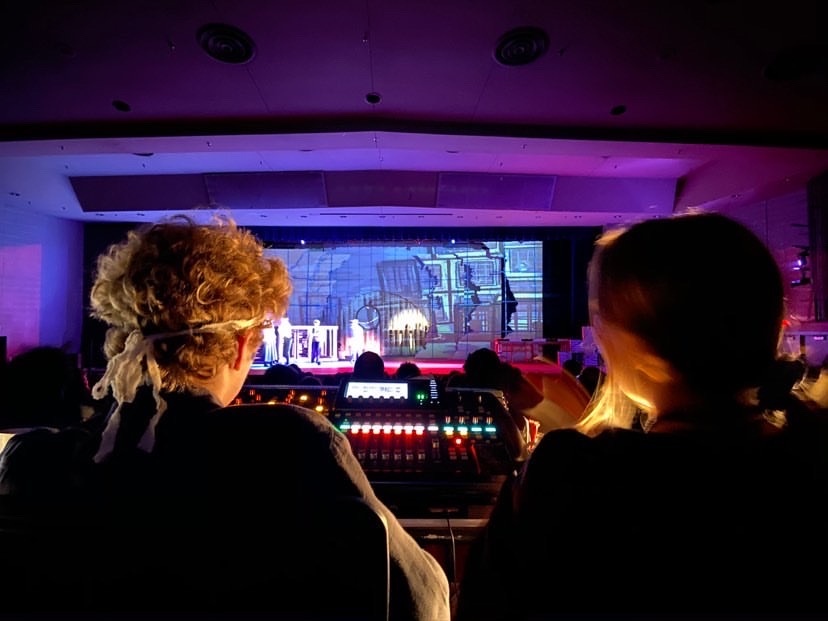
The sound crew begins preparing for each production by setting up wireless mic receivers and running cables to the sound rack, which contains the processing equipment that enhances and controls the audio. Everything is connected through a stage snake — a collection of cables bundled together in one casing — that runs from the stage to the sound booth. The sound crew then adjusts the frequencies of the actor’s mic pack and replaces its batteries before attaching a mic wire to each actor’s face, which connects to the speakers.
The amount of effort and hours that the sound crew puts into the drama department varies, as some shows require more microphones and wires than others. The production of “Clue” only required the sound crew to come in every Thursday before tech week, since there were only eight onstage performers. However, the spring performance, The Mystery of Edwin Drood, required the sound crew to meet every Tuesday and Thursday before tech week because of the pit orchestra and the wiring needed along its perimeter. For the upcoming show, more than 30 microphones are needed, which increases the workload for the sound crew.
Although the work is tenuous, the tech crew collaborates to craft each production with meticulous detail and uniqueness. Over time, members often develop tight bonds, as they understand each other and the work they do.
Madigan Rowles, a member of the sound crew, said that the drama community has made all of the long hours and hard effort worth it, as she describes Whitman Drama as a “family.”
“I’ve met so many articulate and talented individuals,” Rowles said. “If I hadn’t met them, I don’t know who I would be at this moment. It’s shaped my life.”